Skip to content
Lawwise

      Subjects

      This handbook

      Subject

      Environmental Law

      Discharge and emissions permits, waste handling and generator status, contaminated land liability and defenses, environmental review of federal actions, spill reporting duties, and enforcement by agencies and by citizens.

      01
      Environmental Law

      All Appropriate Inquiries Before Buying Land

      All appropriate inquiries is the pre-acquisition investigation required for the innocent landowner, bona fide prospective purchaser and contiguous property owner protections. It must be performed by or under the supervision of an environmental professional meeting stated qualifications, must include specified inquiries and user-supplied information, must be completed within one year before acquisition, and must have five components updated within one hundred eighty days of acquisition.

      6 min readFederal and state

      02
      Environmental Law

      Citizen Suits: Notice, Standing and the Diligent Prosecution Bar

      Most federal environmental statutes authorize any person to sue a violator or the administrator, after serving notice on the agency, the state and the alleged violator. The waiting period is sixty days for most claims and ninety days for endangerment claims under the waste statute. The suit is barred where the agency or state has commenced and is diligently prosecuting a qualifying action. Remedies are injunctive relief, penalties payable to the Treasury, and litigation costs.

      6 min readFederal and state

      03
      Environmental Law

      Contaminated Land Liability and the Defenses to It

      Four classes of person are liable for response costs at a contaminated site: the current owner or operator, the owner or operator at the time of disposal, a person who arranged for disposal or treatment, and a transporter who selected the site. Liability is strict, retroactive and often joint and several. The statute supplies only three defenses, and the practical protections for purchasers and neighbors require pre-acquisition inquiry plus continuing obligations.

      6 min readFederal and state

      04
      Environmental Law

      Self-Disclosure and the Penalty Reduction It Buys

      The federal audit policy waives one hundred percent of the gravity-based penalty where a violation is found through systematic discovery, disclosed voluntarily and promptly, corrected and remediated, and where recurrence is prevented, no repeat or serious harm violation is involved, and the discloser cooperates. Discovery outside a systematic process reduces the waiver to seventy-five percent. Economic benefit is not waived, and the policy binds only the federal agency.

      6 min readFederal and state

      05
      Environmental Law

      Air Permits: Major, Minor and the Synthetic Minor Limit

      Potential to emit is maximum capacity to emit a pollutant under the physical and operational design of the source, counting only federally enforceable limits as restrictions. A source is major at one hundred tons per year of a regulated pollutant, or ten tons of a single hazardous air pollutant or twenty-five tons of a combination, with lower thresholds in nonattainment areas. A source may accept an enforceable limit to stay below a threshold and be permitted as a synthetic minor.

      6 min readFederal and state

      06
      Environmental Law

      Environmental Review: Exclusion, Assessment or Full Statement

      A federal agency proposing an action determines whether it fits a categorical exclusion, requires an environmental assessment, or requires an environmental impact statement. The statute directs a statement where the action has a reasonably foreseeable significant effect on the quality of the human environment, an assessment where the effect is not significant or is unknown, and no document where an exclusion applies. Deadlines of two years and one year apply to the two document levels.

      6 min readFederal and state

      07
      Environmental Law

      Stormwater Permits for Construction Sites and Industrial Land

      Stormwater associated with construction activity disturbing one acre or more, and stormwater associated with activity in one of the listed industrial categories, requires permit coverage. Coverage is normally obtained under a general permit by filing a notice of intent after a pollution prevention plan has been prepared. The plan, the inspection records and the corrective action entries are the compliance record, and coverage ends only on a filed notice of termination.

      6 min readFederal and state

      08
      Environmental Law

      Spill and Release Reporting: What, to Whom, How Fast

      A release of a hazardous substance at or above its reportable quantity within twenty-four hours requires immediate notification to the National Response Center. A release of an extremely hazardous substance also requires immediate notice to the state emergency response commission and the local emergency planning committee, followed by a written report. Oil discharges causing a sheen on navigable waters, and permit and waste rule violations, carry their own separate notifications.

      6 min readFederal and state

      09
      Environmental Law

      Discharge Permits: Who Needs One and What It Limits

      The Clean Water Act forbids the discharge of any pollutant from a point source to waters of the United States except in compliance with a permit. A permit sets technology-based effluent limits drawn from national guidelines, adds water quality-based limits where the receiving water needs them, and imposes sampling, recordkeeping and reporting duties. Terms run no longer than five years, and a renewal application is due one hundred eighty days before expiration.

      6 min readFederal and state

      10
      Environmental Law

      Hazardous Waste Generator Categories and the Duties of Each

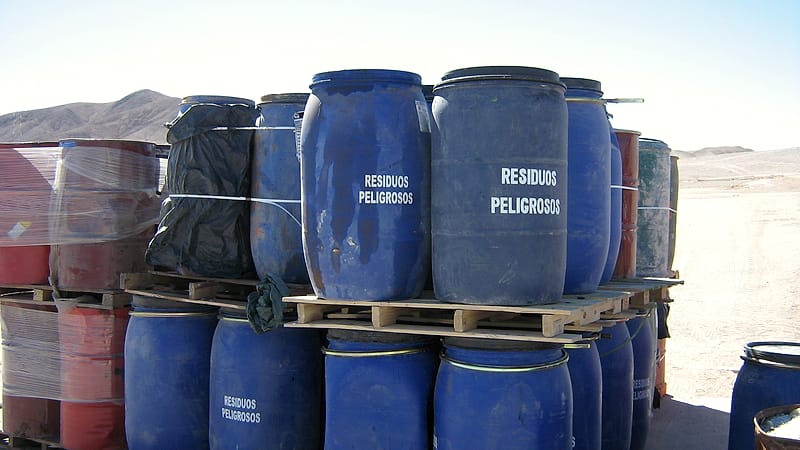
      Generators fall into three categories determined by the quantity of hazardous waste generated in a calendar month: very small quantity generators at or below one hundred kilograms, small quantity generators above one hundred and below one thousand kilograms, and large quantity generators at one thousand kilograms or more. Acute hazardous waste has its own far lower thresholds. Category determines accumulation time, container standards, training, contingency planning and reporting.

      6 min readFederal and state

      11
      Environmental Law

      Used Oil, Universal Waste and the Simpler Handling Tracks

      Used oil managed under 40 CFR part 279 and universal waste managed under 40 CFR part 273 are subject to reduced standards rather than the full generator, transporter and treatment rules. Used oil handling turns on labeling, container integrity, release response and a halogen presumption. Universal waste covers batteries, pesticides, mercury-containing equipment, lamps and aerosol cans, with a one-year accumulation limit and handler duties that scale at five thousand kilograms.

      6 min readFederal and state