Prior Appropriation: First in Time, First in Right
Water in the arid states is not shared in proportion to need or to ownership of the streambank. It is delivered in order of seniority, and a right one day junior to another receives nothing until the older right is satisfied in full.
The rule in short
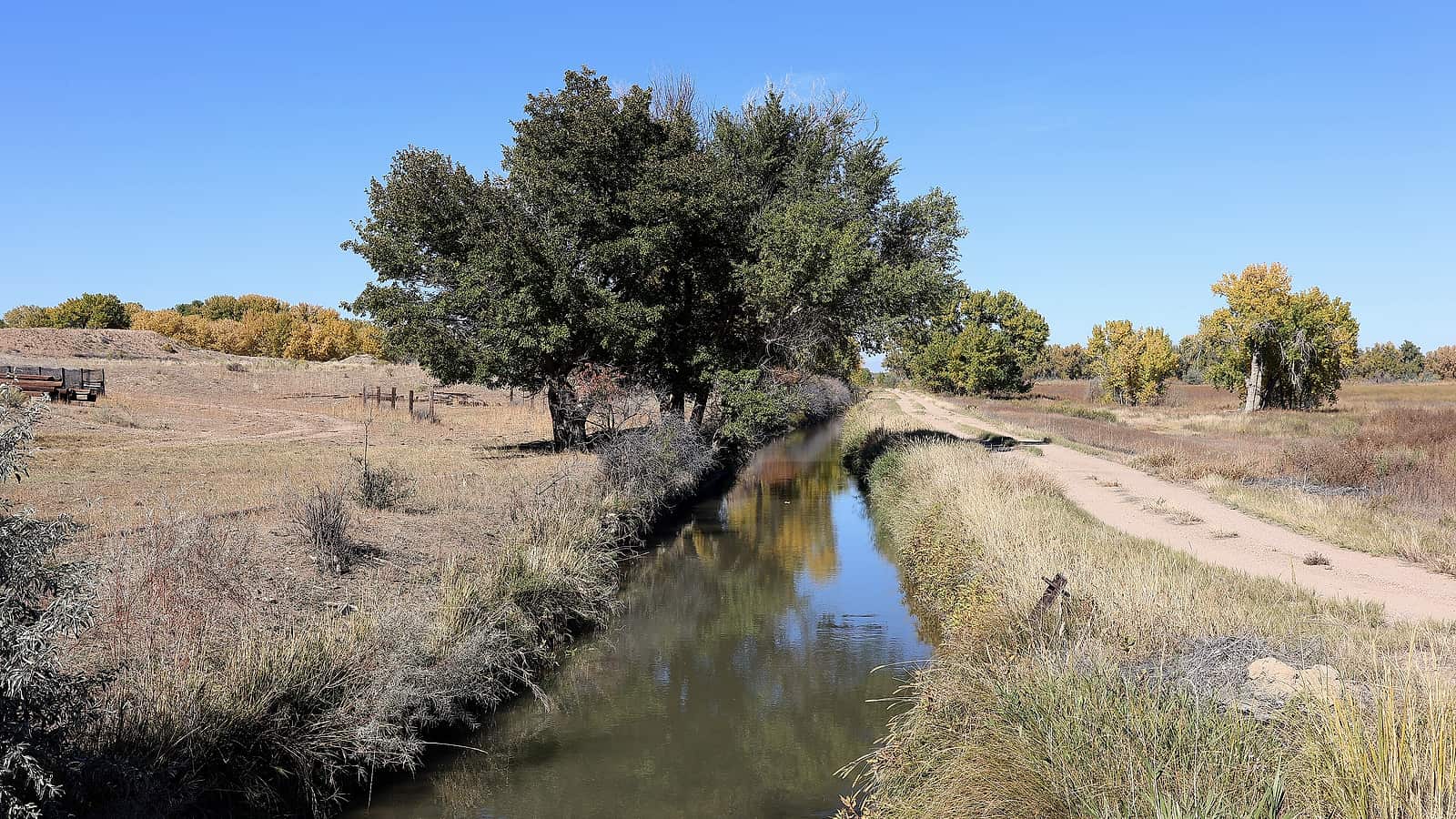
Under prior appropriation a water right is created by diverting water and applying it to a beneficial use, with a priority ranked by the date the effort began. Nearly every western state now administers the doctrine through a permit issued by a state engineer or equivalent officer. In shortage there is no proration: a senior may place a call and junior users are curtailed in reverse order of priority until the senior right is satisfied. Water law is state law, and the details differ.
Riparian law gives water to the owner of the bank. That works where rain is reliable and streams are many. In the arid West it failed immediately, because the mines and fields needing water were nowhere near the streams, so the miners built their own rule: whoever first took water and used it kept the right to keep taking it. Congress later confirmed rights acquired under local custom, and the states built codes on top.
Creating a right
The classical appropriation has three elements: an intent to apply water to a beneficial use, an act of diversion, and actual application of the water to that use within a reasonable time. Intent alone creates nothing. A ditch dug and abandoned creates nothing. The right vests only when water reaches the use.
Nearly every western state now overlays a permit system administered by a state engineer, a department of water resources, or a comparable officer. An applicant files for a permit describing the source, the amount, the point of diversion and the intended use; the agency evaluates whether unappropriated water exists and whether the proposal impairs existing rights or the public interest; a permit issues with conditions and a construction schedule; and on proof that the water has been applied, a certificate or license issues. One state dispenses with the administrative permit entirely and decrees rights through specialized water courts.
The date, and why it is worth more than the quantity
Priority ordinarily relates back to the date the application was filed, or in a pre-code right to the date the first substantial step toward diversion was taken, provided the work continued with reasonable diligence. Relation back is what makes the permit system workable: an applicant who must build a canal is not punished for the time construction takes, so long as the effort is real and continuous.
Seniority is the entire currency of the system. A right for a large quantity with a late date is worth far less in a dry year than a small right with an early one, and the market prices them accordingly. This is why the record of the priority date, and its confirmation in an adjudication, matters more than any other document a water user holds.
The elements that define what is owned
A mature right is not a quantity of water. It is a set of interlocking terms: the source, the point of diversion, the place of use, the purpose of use, the rate or volume allowed, the season during which it may be exercised, and the priority date. Each term is a limit. Water taken from a different source, applied to different land, or used outside the season is not the exercise of the right at all.
Because every term is a limit, changing any of them requires agency or court approval and triggers the injury analysis described under the no-injury rule that governs a change application. The quantity term is also policed from the other direction, since the amount that may actually be taken is capped by beneficial use and the duty of water rather than by the number on the certificate.
When a senior places a call, the administering officer curtails junior diverters in reverse order of priority until the senior is satisfied. That works only where the curtailed water will physically reach the senior in usable quantity. Where distance, channel losses, or the sheer volume of transit make delivery impossible, the call is futile and will not be enforced, because shutting off junior users to no benefit is destruction rather than administration. Futility is a factual question resolved with gage records and channel loss studies.
Shortage: order, not proportion
The defining feature of the doctrine is what happens when supply falls short. Nobody shares. The most junior right on the stream is shut off entirely, then the next, and so on up the list until the senior's decreed amount can be delivered. A junior with a right ten times the size of a senior receives nothing while the senior is short.
Administration is carried out by water masters or commissioners working from a tabulation of rights by priority and from measurements at gages and headgates. Enforcement tools include headgate orders, locking of structures, civil penalties and contempt. In basins where surface and underground supplies are connected, curtailment reaches pumping as well, which is the subject of conjunctive administration of wells against senior surface rights.
Where the doctrine stands beside other systems
| System | How a right arises | Measure of the right | Rule in shortage | Effect of nonuse |
|---|---|---|---|---|
| Prior appropriation | Diversion and beneficial use, usually by permit | Amount beneficially used, with a priority date | Junior rights curtailed in reverse order | Loss by abandonment or forfeiture |
| Riparian | Ownership of land touching the water | Reasonable use in relation to other riparians | Correlative sharing among riparians | Generally none; the right is not lost by nonuse |
| Hybrid states | Riparian rights recognized up to a cutoff, appropriation after | Both systems, by category of right | Appropriative priorities over later claims | Varies by category |
| Federal reserved rights | Implied when land was withdrawn for a purpose | Amount needed for the reservation's primary purpose | Priority from the date of the reservation | Not lost by nonuse |
Several states apply both riparian and appropriative principles, recognizing older riparian claims while allocating everything since by permit. Federal law generally defers to whichever system a state has adopted, with the significant exception of rights implied when the United States reserved land for a purpose. Newer categories, including rights held for flow left in the channel, were grafted onto the same priority framework by statute rather than by the common law that produced it. On the delivery side, most irrigators hold their water through a district that assesses land and delivers by ditch rather than diverting for themselves, and the district's rules govern their day-to-day supply.
Points to carry away
- A right is created by applying water to a beneficial use, not by owning land along the stream.
- Priority is ranked by date, and a senior right is satisfied in full before a junior receives anything.
- Most western states administer appropriations through a permit issued by a state agency.
- A permit's priority ordinarily relates back to the date the application was filed.
- A completed right is defined by source, point of diversion, place and purpose of use, quantity and season.
- A senior's call need not be enforced where curtailment would not actually deliver usable water.
Questions readers ask
Does buying land automatically bring the water with it?
Not automatically, and the assumption causes more losses than any other in this field. In many states a water right is appurtenant to the land it serves and passes with a conveyance unless expressly reserved, while in others it is separate property that must be described and conveyed in its own right. Some rights are held by a district or a mutual company and are represented by shares rather than by a state record. A title search that stops at the deed misses all three possibilities.
What does a right expressed in cubic feet per second actually guarantee?
A rate of flow, not a volume, and only when water is physically available at the point of diversion in the season allowed. A right stated as a flow rate is often paired with an annual volume limit and always bounded by the amount that can be beneficially used without waste. A holder cannot store the difference between the paper rate and actual use, cannot sell the unused portion as if it were owned, and cannot expand consumption up to the paper figure after years of using less.
Do these rules apply to water on federal land?
State appropriation law generally governs the use of water on federal land, because Congress severed water from the public domain in the arid states and left its allocation to state systems. Two categories sit outside. Water expressly reserved when federal land was withdrawn for a particular purpose carries a federal right with its own priority. And water delivered from a federal reclamation project is governed by the project's contracts and repayment obligations alongside the underlying state right.
Sources
- Cornell Legal Information Institute — 43 U.S.C. 661, Appropriation of waters; easementsThe congressional recognition of water rights acquired under local custom and state law.
- Cornell Legal Information Institute — 43 U.S.C. 383, Vested rights and State laws unaffectedThe reclamation statute's direction that federal projects proceed in conformity with state water law.
- Cornell Legal Information Institute — 43 U.S.C. 372, Appurtenance of water right to landThe rule tying a project water right to the land irrigated and to beneficial use as its measure.
- U.S. Geological Survey — Water ResourcesStreamflow measurement and the hydrologic data on which administration of a call depends.
- USGS National Water Information SystemGage records used to establish availability at a point of diversion.
- Bureau of ReclamationThe federal agency delivering project water under contracts layered on top of state rights.
Lawwise is a publication, not a law firm. This article states general rules and cites its sources; it is not advice about any particular case, and the law differs by state and changes over time.
More in Water Rights

Groundwater Management Areas and Pumping Limits
Most western states allocate groundwater by appropriation, while others apply absolute ownership, reasonable use or correlative rights. Where levels decline or wells interfere, a state agency may designate a management area after study and hearing. Designation supports a moratorium on new permits, well spacing, metering, allocations stated per irrigated acre, and scheduled reductions.
Interstate Compacts and Equitable Apportionment
Rivers crossing state lines are divided in three ways: a compact negotiated by the states and consented to by Congress, an equitable apportionment decreed by the Supreme Court, or an apportionment enacted by statute. A consented compact becomes federal law and cannot be altered by one state. Enforcement lies in the Court's exclusive original jurisdiction over controversies between states.
Abandonment and Statutory Forfeiture of a Water Right
A water right can be lost in two ways that are routinely confused. Abandonment is a common law doctrine requiring both nonuse and an intent to relinquish, proved by the party asserting it, with prolonged nonuse serving as evidence of intent rather than as a substitute for it. Forfeiture is statutory and operates on nonuse alone for a fixed term, commonly five years, subject to statutory excuses and to a declaration procedure with notice and a right to be heard.